
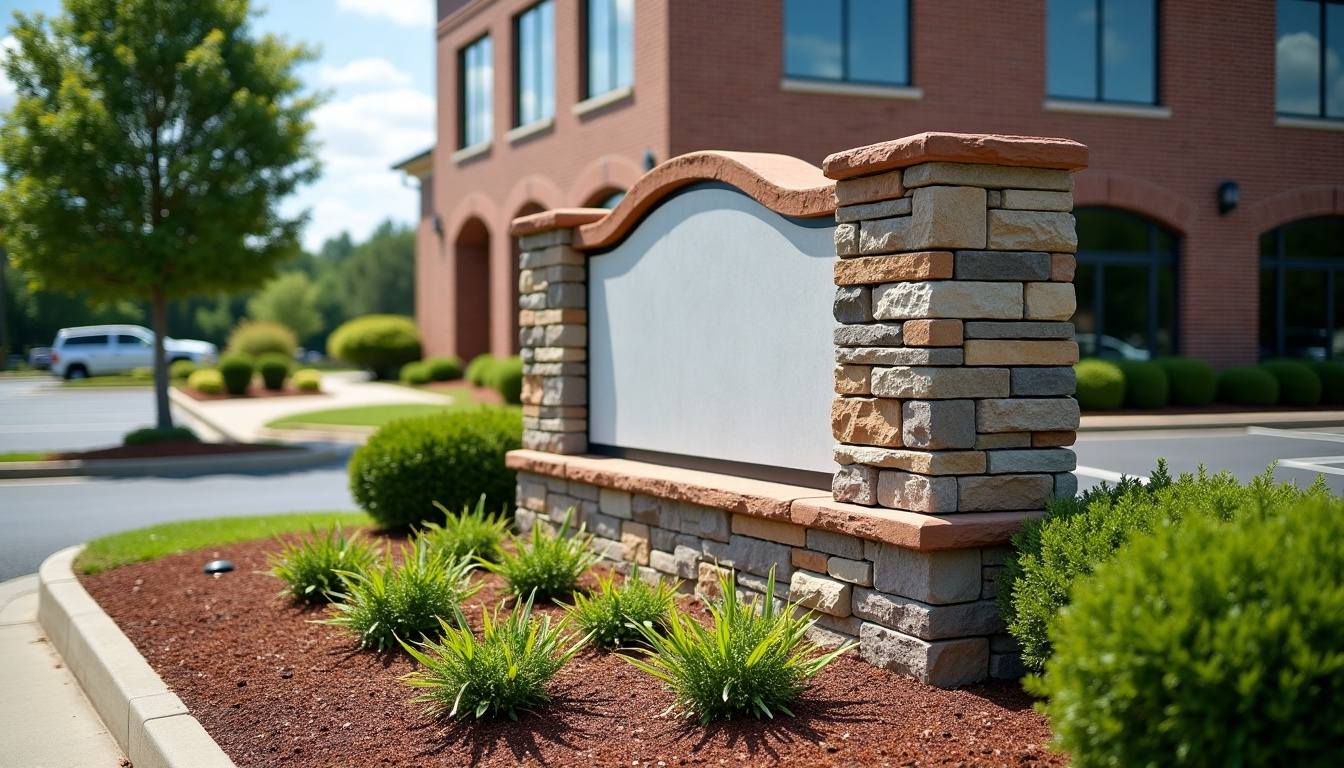
Business Monument Signs
A driver on Wendover Avenue at forty-five miles an hour has a couple of seconds to read your name and decide to turn. A wall sign set back behind a parking lot often loses that race. A ground sign at the curb cut, low and close to the road, wins it.
That is the job of a business monument sign. It marks the driveway, carries the name and the street number, and tells people they have found the right place. Around the Friendly Center area and along High Point Road, low ground signs are the common look, and a well-built one makes a small office read like an established business.
Brick, stone or aluminum: picking the build
Brick is the most common base we build. It matches a lot of Greensboro buildings, it lasts, and it takes a cast stone cap and a recessed panel well. We match brick color to the building where we can, so the sign looks like it was planned with it.
Stone costs more and reads heavier. Stacked stone or a stone veneer over a block core suits medical offices, banks, law offices and anywhere the building itself uses stone. It also stands up well to the summer storms that hit the Triad.
Aluminum post and panel is the lighter option. Two posts, a routed aluminum face, sometimes a decorative cap and base trim. It goes up faster, the face is easy to change when a tenant moves out, and it fits a site where a full masonry base would crowd the planting bed. Many sites end up with a mix, such as an aluminum cabinet sitting on a short brick base.
Office parks and medical centers
Multi-tenant signs need a different plan. An office park or medical center sign usually has a main name at the top and a set of tenant panels below it. Those panels have to come out and go back in without a crew rebuilding the sign every time a lease turns over.
We build the tenant section as replaceable panels in a frame, sized so the smallest name is still readable from the drive. For medical buildings, we also think about patients who are hunting for a suite number while driving slowly through a lot, which means bigger street numbers and a second directional sign where the drive splits. If the property wants the sign lit, the options are on the page about lighting a ground sign.
Reading the Greensboro sign rules before we draw
Freestanding signs inside Greensboro city limits are reviewed under the city's development ordinance, and a sign permit comes from the city's inspections office. The rules cover things like size, height and placement, and they vary by zoning district. We check the zoning on your lot before we put a single line on the drawing, so you never fall for a design that cannot be permitted.
We prepare the permit drawings and submit the application. Outside the city the reviewing office changes: High Point has its own, and unincorporated land goes through the county. For businesses south of town, our work down in High Point runs through that city's process instead.
Footings in Piedmont clay
The part of a monument sign that fails first is usually underground. Piedmont red clay holds water and heaves as it wets and dries, so a base sitting on a thin pad will move. First a hairline crack shows in the mortar, then a gap opens at the cap, and a few years later the whole sign is leaning toward the parking lot.
We size every footing to the sign and dig below the soft top layer. We put gravel under and around the footing so water drains away instead of sitting against the concrete, and we tie the masonry or the posts into the footing with steel. It costs a little more up front and it is the main reason a sign still stands plumb years later.
How a project runs, drawing to install
First we visit the site. We measure the spot, check what a driver sees coming from each direction, and note the planting bed, the irrigation and any lights already there. Then we draw the sign to scale with materials, colors and letter sizes marked.
When the drawing is approved, we file the permit. Before any digging, we call for utility locates, since most commercial lots have power, water and data lines running near the road. Then the crew digs and pours the footing, lets it cure, builds the base, sets the face and cleans up the bed. A lit sign also gets its power run and a final test after dark.
What drives the price
Size matters most, followed closely by material. A small aluminum post and panel sign and a long stone sign with a cast cap are very different jobs. Every sign is quoted by size, materials and lighting, with a drawing and the price in writing before any digging starts, so there is no number on this page and no surprise later.
Other things move the price too: how many tenant panels there are, whether the letters are flat, routed or dimensional, how far power has to run for a lit sign, and whether an old sign has to come out first. If you already have a base in decent shape, a new face may be all you need, and that is a job for our refresh and repair crew.
Get a drawing and a price
Send the form with your address and the name as you want it to read, then text a photo of the spot from the road to 336-579-0766. We reply with questions or a time to measure. The shop is open Monday through Thursday from 8 AM to 5 PM and Friday from 8 AM to noon, closed on weekends, so a Friday afternoon request is answered first thing Monday. Call us or send the form, whichever is easier.
Mon–Thu 8 AM–5 PM · Fri 8 AM–12 PM · Sat–Sun closed